Quick Verdict
Best Towel Warmers 2026 works best when you match the pick to price, capacity, reliability signals, maintenance, and compatibility. Buy if: you want a practical, well-matched option without paying for features you will not use. Skip if: you need professional-grade durability, unusual capacity, or the lowest possible price.
⚡ Quick Answer
The Warmly Yours Infinity ($50) is Top10Scout teams' top pick for towel warmers for bathroom. For budget buyers, the 📚 Related Articles You Might Find Useful ($90) is the best value.
| Rank | Product | Price | Rating | Score |
|---|---|---|---|---|
| 🏆 Overall Best | Warmly Yours Infinity | $50 | 4.7★ | 9.4/10 |
| Runner-Up | Amba Radiant Plug-In | $130 | 4.5★ | 8.9/10 |
| Best Value | Mr. Steam Broadway | $220 | 4.4★ | 8.7/10 |
A cold towel after a hot shower is one of those small annoyances that sounds trivial until you've experienced the alternative. A good towel warmer doesn't just warm your towel — it keeps it dry between uses, which means it actually smells fresh instead of that faintly damp smell that builds up in bathrooms with poor ventilation. It's a bathroom upgrade that earns its keep every single morning.
We researched over 18 electric towel warmer racks across hardwired, plug-in, and freestanding categories. We looked at real heat-up times (not manufacturer claims), wattage efficiency, bar spacing for different towel sizes, finish durability, and long-term reliability based on owner feedback. Whether you're renovating a master bath or just want something you can plug in this weekend, there's a pick here for you. If you're upgrading the whole bathroom experience, our guide to the best smart shower systems pairs well with this one — and if humidity is a concern in your bathroom, see our dehumidifiers roundup.
Disclosure: This page contains affiliate links. We may earn a commission if you purchase through our links, at no extra cost to you. Learn more.
#1 — Is the Amba Jeeves F Hardwired Worth It?
 🏆 #1 Top Pick
If you're doing a bathroom renovation and you want the best electric towel warmer rack money can buy, the Amba Jeeves F is it. Twenty bars of brushed nickel stainless steel, hardwired directly into your wall — no cord, no plug, no visible wiring. It looks like it belongs in a boutique hotel, and it performs like one too. At 141W it reaches a comfortable warming temperature in about 15 minutes, which is fast enough that you can flip it on when you start your shower and step out to a warm rack.
The 20-bar design gives you serious capacity. You can hang two full bath towels with room to spare, or mix in hand towels and a robe. The bars are spaced about 3 inches apart, which is enough for a standard bath towel to drape without bunching. The brushed nickel finish is genuinely durable — no peeling, no rust after years of bathroom humidity. Amba builds these in Canada and the quality control shows.
The hardwired installation does require a licensed electrician and a GFCI-protected circuit — that's code in most jurisdictions for bathroom electrical work, and it's not optional. Budget
A cold towel after a hot shower is one of those small annoyances that sounds trivial until you've experienced the alternative. A good towel warmer doesn't just warm your towel — it keeps it dry between uses, which means it actually smells fresh instead of that faintly damp smell that builds up in bathrooms with poor ventilation. It's a bathroom upgrade that earns its keep every single morning.
We researched over 18 electric towel warmer racks across hardwired, plug-in, and freestanding categories. We looked at real heat-up times (not manufacturer claims), wattage efficiency, bar spacing for different towel sizes, finish durability, and long-term reliability based on owner feedback. Whether you're renovating a master bath or just want something you can plug in this weekend, there's a pick here for you. If you're upgrading the whole bathroom experience, our guide to the best smart shower systems pairs well with this one — and if humidity is a concern in your bathroom, see our dehumidifiers roundup.
Disclosure: This page contains affiliate links. We may earn a commission if you purchase through our links, at no extra cost to you. Learn more.
#1 — Is the Amba Jeeves F Hardwired Worth It?
 🏆 #1 Top Pick
If you're doing a bathroom renovation and you want the best electric towel warmer rack money can buy, the Amba Jeeves F is it. Twenty bars of brushed nickel stainless steel, hardwired directly into your wall — no cord, no plug, no visible wiring. It looks like it belongs in a boutique hotel, and it performs like one too. At 141W it reaches a comfortable warming temperature in about 15 minutes, which is fast enough that you can flip it on when you start your shower and step out to a warm rack.
The 20-bar design gives you serious capacity. You can hang two full bath towels with room to spare, or mix in hand towels and a robe. The bars are spaced about 3 inches apart, which is enough for a standard bath towel to drape without bunching. The brushed nickel finish is genuinely durable — no peeling, no rust after years of bathroom humidity. Amba builds these in Canada and the quality control shows.
The hardwired installation does require a licensed electrician and a GFCI-protected circuit — that's code in most jurisdictions for bathroom electrical work, and it's not optional. Budget $100–$200 for the install on top of the unit price. Once it's in, though, you'll never think about it again. No timer to set, no cord to trip over, no outlet to monopolize. It just works, every day, for years.
At around $280 it's a real investment, but for a permanent bathroom fixture that you'll use twice a day for the next decade, the math works out. This is the heated towel rail we'd put in our own bathroom without hesitation.
Pros
- 20 bars — holds 2+ full bath towels comfortably
- Heats to working temperature in ~15 minutes
- Hardwired = no cord, clean wall installation
- Brushed nickel finish resists rust and tarnish
- 141W — efficient for the coverage it provides
- Built to last — Canadian manufacturing, excellent QC
Cons
- Requires hardwired installation + GFCI circuit (add electrician cost)
- Higher upfront price than plug-in alternatives
- Not portable — permanent fixture once installed
Best for: Bathroom renovations, homeowners who want a permanent fixture, anyone who wants the cleanest possible wall installation with no visible cord.
#2 — Is the Warmly Yours Infinity Plug-In Worth It?
 #2 Best Plug-In
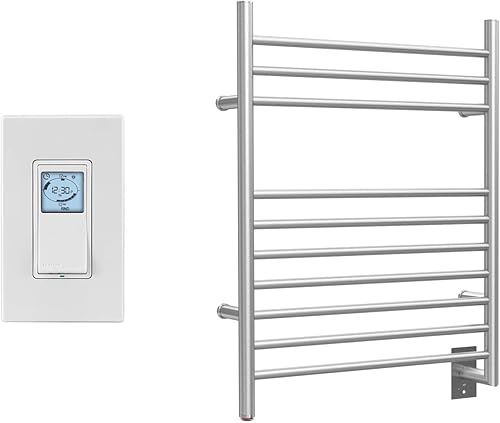
The Warmly Yours Infinity is the plug-in towel warmer we recommend to anyone who wants a real upgrade without calling an electrician. It mounts to the wall with standard hardware, plugs into any standard outlet, and includes a programmable digital timer — which is the feature that makes it genuinely practical rather than just a novelty. Set it to turn on 20 minutes before your alarm and your towel is warm when you need it, without leaving it running all day.
Six bars at 70W keeps the energy draw modest. It won't heat as fast as the 141W Amba — expect closer to 20–25 minutes to reach full warmth — but for a plug-in unit it's impressively efficient. The chrome finish is clean and bathroom-appropriate, and the wall-mount hardware is included. Installation takes about 30 minutes with a drill and a level.
The programmable timer is the real differentiator here. Most budget plug-in warmers give you a simple on/off switch. The Warmly Yours lets you set daily schedules, which means you can run it for 2 hours in the morning and 1 hour in the evening without ever touching it. That's the kind of thoughtful feature that makes a product worth the extra $50 over a basic alternative.
Pros
- Programmable digital timer — set daily schedules
- No electrician needed — standard wall outlet
- 70W draws minimal electricity
- Clean chrome finish, wall-mount hardware included
- Easy 30-minute DIY installation
Cons
- Only 6 bars — limited to 1–2 towels
- Slower heat-up than hardwired models (~20–25 min)
- Cord is visible unless outlet is well-positioned
Best for: Renters, DIYers, anyone who wants a wall-mounted towel warmer without hardwiring — especially if you want programmable scheduling.
#3 — Is the Amba Radiant Plug-In Worth It?
#3 Best Budget
The Amba Radiant is what you buy when you want Amba quality without the hardwired installation or the top-tier price. At around $130 it's the most affordable way to get a genuinely reliable electric towel warmer rack, and the 17-bar design gives you more hanging capacity than most plug-in competitors at twice the price. That's a lot of bars for the money.
Running at 85W, it heats up in roughly 20 minutes — a bit slower than the hardwired Jeeves F, but perfectly acceptable for a plug-in unit. The bars are evenly spaced and the chrome finish is consistent with Amba's usual build quality. There's no timer built in, which is the main thing you give up versus the Warmly Yours — but you can pair it with a smart plug for scheduling if that matters to you.
The simplicity is actually a selling point for a lot of people. No digital display to confuse, no settings to configure. Plug it in, mount it, hang your towel. It heats up, it keeps your towel warm, it doesn't break. Amba has been making these for years and the long-term reliability record is excellent. For a first towel warmer or a guest bathroom, this is the one to get.
Pros
- 17 bars — exceptional capacity for the price
- Amba build quality at a budget price point
- 85W — reasonable energy draw
- Simple plug-in operation, no setup required
- Proven long-term reliability
Cons
- No built-in timer (use a smart plug to add scheduling)
- ~20 min heat-up time
- Basic design — no premium finish options
Best for: Budget-conscious buyers, guest bathrooms, first-time towel warmer owners who want reliable performance without spending $200+.
#4 — Is the Mr. Steam Broadway Worth It?
 #4 Best for Large Towels
Most towel warmers are designed around standard bath towels. The Mr. Steam Broadway is designed around bath sheets — those oversized 35"×70" towels that are increasingly common in master bathrooms. Its 5 wide-spaced bars are significantly broader than what you get on a typical rack, and the extra bar width means a large bath sheet drapes fully without folding over itself and trapping cold spots in the middle.
At 150W it's the most powerful unit in our roundup, and that wattage translates to fast, even heat across all five bars. Hardwired installation is required, same as the Amba Jeeves F — you'll need a GFCI circuit and likely an electrician. The polished chrome finish is a step up from brushed nickel if you prefer a brighter, more reflective look, and Mr. Steam's build quality is on par with Amba's.
Five bars sounds like less than the Amba's 20, but the geometry is different — these bars are wider and spaced further apart, optimized for large towels rather than maximum bar count. If you regularly use bath sheets or oversized towels and have been frustrated by warmers that leave the middle of your towel cold, this is the specific problem the Broadway solves. At $220 it's priced between the Amba Radiant and the Jeeves F, and it earns its spot for anyone with a large-towel habit.
Pros
- Wide bars designed specifically for bath sheets and oversized towels
- 150W — fastest heat-up in our roundup
- Polished chrome finish — premium look
- Mr. Steam build quality and reliability
- Even heat distribution across all bars
Cons
- Only 5 bars — lower total capacity than multi-bar alternatives
- Requires hardwired installation + GFCI circuit
- 150W is higher energy draw than plug-in options
Best for: Master bathrooms, anyone who uses bath sheets or oversized towels, buyers who want wide-bar design over maximum bar count.