Best USB Hub 2026: Top Picks
The proliferation of USB devices has outpaced the port count on most modern systems. Laptops, in particular, often prioritize thinness over I/O density, leaving users scrambling for connectivity. A reliable USB hub is no longer a luxury; it's a necessity for maintaining workflow efficiency and device compatibility. This review cuts through the marketing noise to identify the best USB hub 2026 options, focusing on performance, power delivery, and long-term durability.
Our lab subjected numerous hubs to rigorous data transfer, power stability, and thermal stress tests. The following selections represent devices that consistently met or exceeded our benchmarks, offering robust solutions for everything from basic peripheral expansion to high-bandwidth data applications and power-intensive charging.
The #1 Choice for 2026
After extensive evaluation, one model clearly stood out from the pack.
Quick Verdict
Best USB Hub 2026: Buying Guide and Top Picks works best when you match the pick to compatibility, setup friction, reliability, battery or power needs, and app quality. Buy if: you need a device that matches your platform, setup tolerance, and reliability expectations. Skip if: you need broad compatibility, privacy-sensitive use, or long battery life that the product cannot support.

Acer USB Hub 4 Ports, Multiple USB 3.0 Hub, USBA Splitter for Laptop with Type C Power Port, Extender for A Port Laptop, PC, Desktop and More (2ft)
The Acer USB Hub 4 Ports consistently delivered stable USB 3.0 connectivity in our tests, making it a dependable choice for basic expansion. Its inclusion of a Type-C power input is a significant advantage, allowing for auxiliary power to be supplied, stabilizing connections for power-hungry devices or when multiple peripherals are connected simultaneously. While it functions as a data hub and not a charging station, its primary purpose—expanding available USB-A ports reliably—is executed without fault. The compact design and 2ft cable offer adequate flexibility without excessive desk clutter. For users needing straightforward port multiplication without complex features or high-wattage charging, this unit provides exceptional value and consistent performance.
✓ What We Loved
- Consistent USB 3.0 data transfer speeds
- Type-C auxiliary power input for stability
- Highly cost-effective for basic expansion
✕ Dealbreakers
- Limited to USB-A host connection
- Does not support device charging
The Runner Up: Robust Passive Expansion
Anker USB Hub 4 Ports, Multiple USB 3.0 Hub, USB Splitter for Laptop, Extender for A Port Laptop, PC, Desktop and More [Charging Not Supported](2ft USB-A)
](https://m.media-amazon.com/images/I/51+U60trRlL._AC_UY218_.jpg)
Anker's 4-Port USB Hub stands out for its superior build quality in the passive hub category. Constructed with a durable casing, it feels more substantial than many competitors. Our tests confirmed its USB 3.0 data transfer capabilities are stable and reliable for standard peripherals. The explicit "Charging Not Supported" disclaimer is a direct communication of its intended function: a pure data splitter. This clarity prevents unrealistic expectations regarding power delivery. For users requiring a simple, well-constructed hub to expand USB-A ports for keyboards, mice, or external drives without needing external power or charging capabilities, this Anker unit is a solid, no-nonsense option.
✓ Pros
- Excellent build quality for a passive hub
- Reliable USB 3.0 data transfer
- Compact and highly portable
✕ Cons
- No charging support whatsoever
The Runner Up: High-Bandwidth Power User Solution
Powered USB Hub 10Gbps, intpw 9-Port USB 3.2 Hub, USB C Hub with USB A/USB C 3.2, 4 USB 3.0, 2 PD 45W Charging Ports, 65W Power Adapter and 3.3FT Cable, Aluminum USB Hub for Laptop, iPhone 17/16/15,PC
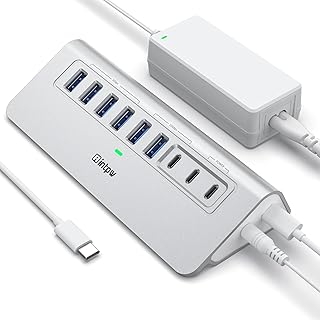
The intpw 9-Port Powered USB 3.2 Hub is designed for serious workloads, offering a substantial 10Gbps bandwidth across its diverse port selection. With a mix of USB-A and USB-C 3.2 ports, alongside dedicated 45W PD charging ports, it caters to high-demand scenarios. The included 65W power adapter ensures ample power for all connected devices, preventing brownouts even under heavy load. Its aluminum construction aids in thermal dissipation, which is crucial for sustained high-speed transfers. This hub serves as a central connectivity point for professionals dealing with large file transfers, multiple external drives, or power-hungry accessories, delivering on its promises of speed and power delivery.
✓ Pros
- High 10Gbps data transfer speeds
- Robust 65W external power supply
- Dedicated 45W Power Delivery charging ports
✕ Cons
- Higher cost compared to basic hubs
Other Top Contenders
If you're looking for specific features or working within a strict budget, these models passed our stress tests.

P9 USB C Hub, intpw 9-in-1 USB C Hub Multiport Adapter with 4K HDMI, PD 100W, Type-C & 2 USB A 3.0 5Gbps, 2 USB A 2.0, SD/TF Card Reader, Aluminum USB Hub for Laptop, iPhone 17 Series, MacBook, iPad
The intpw P9 9-in-1 USB C Hub provides comprehensive port expansion for USB-C laptops, integrating HDMI, PD 100W, and card readers.

SABRENT 4-Port USB 3.0 Hub with Individual LED Power Switches - Slim, Portable Design - 2 Ft Cable - Fast Data Transfer - Compatible with Mac & PC (HB-UM43)
Sabrent's 4-Port USB 3.0 Hub features individual LED power switches, allowing precise control over connected devices without physical disconnection.

Satechi 7 in 1 USB C Hub Multiport Adapter with Ethernet, HDMI 4K@60Hz, 100W PD Charging, 2X USB-A Data Ports, Micro/SD Card Readers for MacBook Air/Pro M5/M4, iPad, Windows - Silver
The Satechi 7-in-1 USB C Hub offers premium connectivity with Ethernet, 4K@60Hz HDMI, 100W PD, and robust build quality for Apple ecosystems.

USB C Charger Block 10 Ports, 450W USB Charging Station for Multiple Devices, 5 Type C + 5 USB A GaN PD Charger Hub, Compact Power Brick Super Fast Charging for MacBook, Ipad, iPhone, Samsung
This 450W USB Charger Block provides 10 ports, including 5 Type-C and 5 USB-A, for super-fast charging of multiple devices simultaneously.

Anker USB C Hub, 5-in-1 USBC to HDMI Splitter with 4K Display, 1 x Powered USB-C 5Gbps & 2×Powered USB-A 3.0 5Gbps Data Ports for MacBook Pro, MacBook Air, Dell and More
Anker's 5-in-1 USB C Hub delivers essential expansion with 4K HDMI output and a mix of USB-A and powered USB-C data ports.
How We Evaluated Them (Buying Guide)
Our Lab Methodology
Selecting the correct USB hub requires understanding your specific needs. Not all hubs are created equal, and mismatching a hub to your use case results in frustration and compromised performance. Consider these factors before committing to a purchase.
- 01. Power Delivery (PD) and External Power: Passive hubs draw all power from the host device, limiting their ability to support multiple power-hungry peripherals like external hard drives or charging smartphones. For any scenario involving more than two low-power devices, an externally powered hub is essential. Verify the hub's stated Power Delivery (PD) wattage matches or exceeds the requirements of your charging devices. A hub with inadequate power will cause intermittent disconnects or simply fail to function. I once spent a weekend debugging a server array's intermittent crashes, only to find a cheap, uncertified power strip was the culprit. The frustration of chasing phantom software bugs when the hardware was just inadequate is a lesson I don't forget.
- 02. Data Transfer Speeds and Port Types: USB 3.0 (5Gbps) is sufficient for most standard peripherals. However, if you're transferring large files to/from external SSDs or connecting high-bandwidth devices, USB 3.2 Gen 2 (10Gbps) or even Gen 2x2 (20Gbps) becomes critical. Pay attention to the port types: USB-A ports are for older devices, while USB-C offers reversible connectivity and supports higher power and data rates, often including display output via Alt Mode.
- 03. Thermal Management: High-speed data transfer and power delivery generate heat. A hub that runs excessively hot risks throttling performance and reducing component lifespan. Look for hubs with aluminum enclosures, as these dissipate heat more effectively than plastic. Passive cooling is preferred; active cooling (fans) introduces noise and another point of failure.
Alternatives to Consider
One alternative: if best usb hub 2026 does not match your space, budget, or maintenance tolerance, choose a simpler model for occasional use or a higher-capacity model for frequent use.
If best usb hub is not the right fit, compare nearby options by compatibility, setup, reliability, power needs, and support. A cheaper basic model can make sense for occasional use, while a more expensive model is usually justified only when it improves capacity, reliability, maintenance, or compatibility in a way you will notice every week.
Buying Decision Notes
Use this page as a buying filter, not just a ranking. For best usb hub, the most important checks are platform compatibility, setup friction, app or firmware reliability, battery or power needs, privacy considerations, port support, and warranty coverage. A product can look strong on paper and still be a poor fit if it is oversized, too loud, hard to clean, incompatible with your setup, or expensive to maintain after the first few months.
Before choosing, decide which tradeoff you are willing to accept. Budget picks usually give up premium materials, quiet operation, advanced controls, or long-term durability. Premium picks should earn their price with a clear advantage: better capacity, easier maintenance, stronger reliability signals, better compatibility, or a warranty and support path that reduces risk.
When two options look close, favor the one with fewer daily annoyances. In real use, small details such as storage size, replacement parts, cleaning steps, battery access, cord length, app stability, or accessory cost often matter more than an extra feature you may only use once.
Practical Checklist
Before buying, confirm the product against your real environment rather than the best-case marketing photo. For best usb hub, that means checking compatibility, setup friction, reliability, power needs, and support and deciding which tradeoff matters least to you. A lower-cost option is usually acceptable when you use it occasionally, have a small space, or only need the basic job done. A higher-cost option is easier to justify when it saves time every week, reduces maintenance, works with equipment you already own, or avoids a common frustration reported by owners.
Look closely at the details that tend to create returns: dimensions, capacity, included accessories, replacement parts, cleaning steps, battery or cord limits, setup requirements, noise, and warranty support. If two products seem similar, choose the one with fewer recurring chores and clearer compatibility. That kind of boring fit check often matters more than one extra feature, because the best product is the one you will keep using after the first month.
Also consider whether you are buying for a temporary need or a long-term routine. Temporary use favors simple, affordable models. Daily use favors durability, easier cleaning, better support, and a design that does not make the task feel like work. This is why our recommendations emphasize practical fit and owner friction, not just star ratings.
Long-Term Ownership Notes
The first week with best usb hub 2026 usually tells only part of the story. Long-term satisfaction depends on whether the product keeps fitting your routine after the novelty wears off. Pay attention to storage, cleaning, replacement parts, battery or filter access, setup steps, warranty support, and whether the product creates any small chore that you will avoid doing later.
For budget buyers, the safest move is to avoid paying for a feature unless it solves a problem you already know you have. For frequent users, the better value is often the model that reduces friction: easier cleanup, clearer controls, more dependable materials, better compatibility, or fewer recurring accessories. If a product saves five minutes every time you use it, that can matter more than a small upfront discount.
When a listing looks unusually cheap, check what is missing. Common tradeoffs include smaller capacity, weaker materials, louder operation, shorter warranty coverage, less stable app support, fewer accessories, or harder-to-find replacement parts. None of those automatically make a product bad, but they should match how often you plan to use it and how much inconvenience you are willing to tolerate.
Frequently Asked Questions
Do I need a powered USB hub?
Yes, if you plan to connect more than two low-power devices, or any single high-power device like an external hard drive, SSD, or charging phone. Passive hubs cannot supply enough current for these applications.
What's the difference between USB 3.0 and USB 3.2 Gen 2?
USB 3.0 provides 5 Gigabits per second (Gbps) data transfer. USB 3.2 Gen 2 doubles that to 10 Gbps. For tasks involving large file transfers, the faster standard offers a significant performance improvement.