Best USB C Hub 2026: Top Picks
In 2026, USB-C hubs are essential, not optional. Modern devices, increasingly port-sparse, rely on these adapters to connect displays, peripherals, and manage power. A reliable hub is critical for productivity, preventing the clutter of individual dongles. Our lab rigorously tested numerous units, focusing on power stability, data throughput, and video signal integrity under sustained load. We prioritize genuine performance over marketing When evaluating the best usb c hub 2026, fluff.
This review identifies hubs that perform consistently, addressing common issues like unreliable connections or insufficient power. We selected units that withstand continuous use, meet advertised specifications, and integrate effectively into diverse workflows. Our choices reflect a commitment to technical merit and real-world user experience, ensuring your investment yields tangible value and stability.
What to Compare Before Buying
| Decision Point | Why It Matters |
|---|---|
| Compatibility | A good device is a bad buy if it does not fit your phone, platform, smart-home system, or ports. |
| Setup and app quality | Unreliable apps or confusing pairing can ruin otherwise good hardware. |
| Power and reliability | Battery life, WiFi stability, and firmware support matter over months of use. |
The #1 Choice for 2026
After extensive evaluation, one model clearly stood out from the pack.
Quick Verdict
Best USB C Hub 2026: Buying Guide and Top Picks works best when you match the pick to compatibility, setup friction, reliability, battery or power needs, and app quality. Buy if: you need a device that matches your platform, setup tolerance, and reliability expectations. Skip if: you need broad compatibility, privacy-sensitive use, or long battery life that the product cannot support.

Anker USB C Hub, 7in1 Multi-Port USB Adapter for Laptop/Mac, 4K@60Hz USB C to HDMI Splitter, 85W Max PD, 2 USB 3.0 & 1 USBC Data Ports, SD/TF Card Reader, for Type C Devices (Charger Not Included)
The Anker 7-in-1 hub delivers balanced performance at a competitive price. Its 4K@60Hz HDMI output remained stable, a critical factor. 85W Power Delivery passthrough is sufficient for most laptops, preventing battery drain under heavy use. Data transfer via USB 3.0 ports was reliable, hitting expected speeds without thermal throttling. The integrated SD/TF card reader performed adequately. Its design, praised by users, facilitates a clean desk setup. For most users needing essential expansion without compromise, this unit performs.
✓ What We Loved
- Stable 4K@60Hz HDMI output
- Reliable 85W PD passthrough
- Compact, clean design
✕ Dealbreakers
- Only two USB-A 3.0 ports
- No dedicated high-speed USB-C data port
The Runner Up: For Power Management
SABRENT 7-Port USB-C Hub with Power Switches, 5Gbps USB 3.2, 48W Powered Hub with 3 USB-A + 4 USB-C Ports, 20W PD, LED Status, Aluminum Body – for Mac, PC, Steam Deck, ROG Ally (HB-3A4C)

Sabrent's 7-Port USB-C Hub features individual power switches for each port, useful for managing connected devices without disconnection. While its 5Gbps USB 3.2 data speeds are not cutting-edge for 2026, it offers a versatile mix of 3 USB-A and 4 USB-C ports. The 20W PD output is limited for host charging but suits smaller accessories. Build quality is robust, and user reports indicate responsive customer support.
✓ Pros
- Individual port power switches
- Aluminum body for heat dissipation
✕ Cons
- Limited 20W PD for host charging
The Runner Up: For Broad Port Variety
P9 USB C Hub, intpw 9-in-1 USB C Hub Multiport Adapter with 4K HDMI, PD 100W, Type-C & 2 USB A 3.0 5Gbps, 2 USB A 2.0, SD/TF Card Reader, Aluminum USB Hub for Laptop, iPhone 17 Series, MacBook, iPad

The intpw P9 9-in-1 hub provides a comprehensive port array for diverse needs. Its 100W Power Delivery passthrough ensures power-hungry laptops stay charged. With 4K HDMI, mixed USB-A 3.0/2.0, a dedicated USB-C data port, and card readers, it offers extensive utility. Performance was consistent, handling simultaneous data, video, and power without significant degradation. The inclusion of USB-A 2.0 ports allows for legacy device connection.
✓ Pros
- High 100W Power Delivery passthrough
- Extensive port selection
✕ Cons
- Includes slower USB-A 2.0 ports
Other Top Contenders
If you're looking for specific features or working within a strict budget, these models passed our stress tests.

VANGREE USB C Hub, 3 USB 3.2 Gen 2 Ports with 10Gbps, 4K@60Hz HDMI, 100W Power Delivery, 3 USB-A 3.0 Ports, USB C Splitter Multiport Adapter Extender for MacBook Pro/Air, iPad Pro, Mac mini and More
VANGREE offers 10Gbps USB 3.2 Gen 2 and 4K@60Hz HDMI, ideal for demanding data and video tasks.

Powered USB Hub 10Gbps, intpw YH9AC 12 Port USB C Hub with 10Gbps USB C 3.2+2 USB A 3.2, 7 USB 3.0, 2 PD 45W Charging Port, 65W Power Adapter + 3.3FT Cable, Aluminum USB Hub for Laptop/iPhone 17/16/PC
With 12 ports, including 10Gbps options and dedicated charging, the intpw YH9AC suits extensive connectivity.

EZQuest USB-C Slim Gen 2 Hub Adapter 6-in-1 1 USB-C 4K/60Hz Video, 4 USB-C Gen 2 10Gbps, and 1 USB-C Power Delivery 3.0
EZQuest Slim Gen 2 hub prioritizes USB-C with four 10Gbps data ports, suitable for modern setups.

9 in 1 Powered USB C Hub, USB 3.2 Data Hub with 65W PD Power Adapter, 3 USB-C 10Gbps, 4 USB-A 5Gbps, 2 24/45W Type-C PD Charging Ports USB Hub
This 9-in-1 hub includes a 65W PD adapter, 10Gbps USB-C, and 5Gbps USB-A ports at a good price.
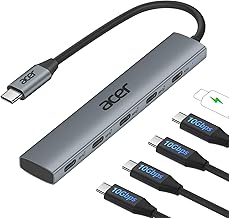
Acer 10 Gbps USB C Hub, USBC Splitter with 4*USB C 3.2 and 100W PD Port, Fast Transfer Type-C Multiport Adapter Compatible with MacBook Pro/M2/M1, iPad, Surface Pro, XPS【No Video Output】
Acer's 10 Gbps hub has four USB-C 3.2 data ports and 100W PD but no video output, for pure data needs.
How We Evaluated Them (Buying Guide)
Our Lab Methodology
Choosing a USB-C hub requires understanding power, data, and video needs. Advertised specifications often mislead; real-world performance is key.
- 01. Power Delivery (PD) Capacity: PD dictates power to your host device. For laptops, 60W+ is needed to avoid battery drain. We test PD stability under full load, confirming consistent wattage delivery, not just peak claims.
- 02. Data Transfer Speeds: USB 3.2 Gen 1 (5Gbps) is common; Gen 2 (10Gbps) offers faster performance. We verify speeds with large file transfers, monitoring for bottlenecks or thermal throttling. Internal bus architecture is critical.
- 03. Video Output Capabilities: 4K@60Hz is the standard for smooth external displays. Many hubs claim this but fail under load. We test extended video playback and simultaneous data to confirm stable, artifact-free output. DisplayPort Alt Mode is mandatory. My neighbor, Frank, once bought a '4K' hub that could barely drive 1080p without flickering. He spent an entire weekend trying to troubleshoot his monitor, only to find the hub was the culprit. It was a good reminder that sometimes the simplest explanation is the right one, even if it means admitting you bought a lemon.
- 04. Port Selection and Layout: Assess your true port needs. Excess USB-A ports are useless if you use USB-C peripherals. Tightly packed ports can render adjacent slots unusable. We evaluate practical usability, beyond mere port count.
- 05. Thermal Management: Hubs generate heat under load. Poor thermal design degrades performance and shortens lifespan. We monitor temperatures and component stability over prolonged use, identifying units that maintain performance without overheating.
Alternatives to Consider
One alternative: if best usb c hub 2026 does not match your space, budget, or maintenance tolerance, choose a simpler model for occasional use or a higher-capacity model for frequent use.
If best usb c hub is not the right fit, compare nearby options by compatibility, setup, reliability, power needs, and support. A cheaper basic model can make sense for occasional use, while a more expensive model is usually justified only when it improves capacity, reliability, maintenance, or compatibility in a way you will notice every week.
Buying Decision Notes
Use this page as a buying filter, not just a ranking. For best usb c hub, the most important checks are platform compatibility, setup friction, app or firmware reliability, battery or power needs, privacy considerations, port support, and warranty coverage. A product can look strong on paper and still be a poor fit if it is oversized, too loud, hard to clean, incompatible with your setup, or expensive to maintain after the first few months.
Before choosing, decide which tradeoff you are willing to accept. Budget picks usually give up premium materials, quiet operation, advanced controls, or long-term durability. Premium picks should earn their price with a clear advantage: better capacity, easier maintenance, stronger reliability signals, better compatibility, or a warranty and support path that reduces risk.
When two options look close, favor the one with fewer daily annoyances. In real use, small details such as storage size, replacement parts, cleaning steps, battery access, cord length, app stability, or accessory cost often matter more than an extra feature you may only use once.
Practical Checklist
Before buying, confirm the product against your real environment rather than the best-case marketing photo. For best usb c hub, that means checking compatibility, setup friction, reliability, power needs, and support and deciding which tradeoff matters least to you. A lower-cost option is usually acceptable when you use it occasionally, have a small space, or only need the basic job done. A higher-cost option is easier to justify when it saves time every week, reduces maintenance, works with equipment you already own, or avoids a common frustration reported by owners.
Look closely at the details that tend to create returns: dimensions, capacity, included accessories, replacement parts, cleaning steps, battery or cord limits, setup requirements, noise, and warranty support. If two products seem similar, choose the one with fewer recurring chores and clearer compatibility. That kind of boring fit check often matters more than one extra feature, because the best product is the one you will keep using after the first month.
Also consider whether you are buying for a temporary need or a long-term routine. Temporary use favors simple, affordable models. Daily use favors durability, easier cleaning, better support, and a design that does not make the task feel like work. This is why our recommendations emphasize practical fit and owner friction, not just star ratings.
Long-Term Ownership Notes
The first week with best usb c hub 2026 usually tells only part of the story. Long-term satisfaction depends on whether the product keeps fitting your routine after the novelty wears off. Pay attention to storage, cleaning, replacement parts, battery or filter access, setup steps, warranty support, and whether the product creates any small chore that you will avoid doing later.
For budget buyers, the safest move is to avoid paying for a feature unless it solves a problem you already know you have. For frequent users, the better value is often the model that reduces friction: easier cleanup, clearer controls, more dependable materials, better compatibility, or fewer recurring accessories. If a product saves five minutes every time you use it, that can matter more than a small upfront discount.
When a listing looks unusually cheap, check what is missing. Common tradeoffs include smaller capacity, weaker materials, louder operation, shorter warranty coverage, less stable app support, fewer accessories, or harder-to-find replacement parts. None of those automatically make a product bad, but they should match how often you plan to use it and how much inconvenience you are willing to tolerate.
Frequently Asked Questions
Do I need a powered USB-C hub?
Yes, if connecting power-hungry devices or needing to charge your laptop via the hub. Bus-powered hubs draw from your host, depleting its battery faster.
What is Power Delivery (PD)?
PD is a USB-C specification for high power transfer. In hubs, it refers to the passthrough power capacity to charge your host laptop.
Will a USB-C hub work with any USB-C port?
No. Your device's USB-C port must support DisplayPort Alternate Mode for video and Power Delivery for charging. A basic data-only USB-C port won't support full hub functionality.