Quick Verdict
Best Smart Plugs for Home Automation (2026) works best when you match the pick to compatibility, setup friction, reliability, battery or power needs, and app quality. Buy if: you need a device that matches your platform, setup tolerance, and reliability expectations. Skip if: you need broad compatibility, privacy-sensitive use, or long battery life that the product cannot support.
⚡ Quick Answer
The Kasa Smart EP25 ($15) is Top10Scout teams' top pick for smart plugs for home automation (. For budget buyers, the Govee Smart Plug ($8) is the best value.
| Rank | Product | Price | Rating | Score |
|---|---|---|---|---|
| 🏆 Overall Best | Kasa Smart EP25 | $15 | 4.7★ | 9.4/10 |
| Runner-Up | Wemo Mini Smart Plug | $25 | 4.5★ | 8.9/10 |
| Best Value | TP-Link Tapo P125M | $15 | 4.4★ | 8.7/10 |
| Premium Pick | Govee Smart Plug | $8 | 4.5★ | 4.7★ |
A smart (Best Smart Shower Systems 2026 — Top10Scout) plug is the easiest entry point into home automation — no wiring, no hub required, just plug it in and your dumb lamp or coffee maker becomes something you can control with your voice or phone from anywhere in the world. But not all smart plugs are created equal. Some work flawlessly with Alexa and Google Home. Others require their own app and refuse to play nicely with anything else. A few have energy monitoring built in; most don't. And the newer Matter-compatible models promise to work with everything, forever — but only if your setup supports it.
We Evaluated over ten smart plugs across different ecosystems, checking app reliability, voice assistant response times, scheduling features, energy monitoring accuracy, and how well each one holds up after months of daily use. The five picks below cover every major use case — from the dead-simple Alexa native option to the future-proof Matter plug to the best budget pick for anyone just getting started. If you want to go deeper into the smart home rabbit hole, our best smart plugs guide covers the full category. And once your plugs are set up, pairing them with smart locks and smart shower systems turns your home into a genuinely automated space.
One thing worth knowing upfront: the smart plug market has fragmented around ecosystems. If you're all-in on Alexa, the Amazon Smart Plug is the path of least resistance. Apple HomeKit users should look at the Wemo Mini. If you want something that works everywhere and will keep working as standards evolve, the TP-Link Tapo P125M with Matter support is the smart long-term buy. Here's the full breakdown.
#1 Amazon Smart Plug — Best for Alexa Users
 🏆 Best Overall
Amazon Smart Plug
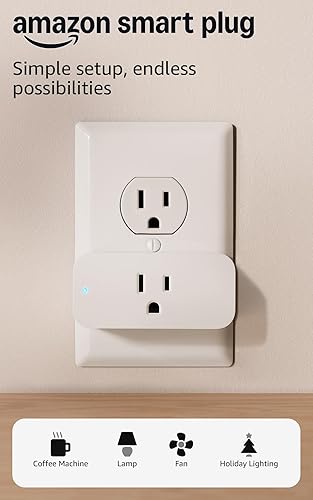
If you use Alexa, the Amazon Smart Plug is the easiest smart plug you can buy — and that simplicity is genuinely its biggest selling point. Setup takes about two minutes: plug it in, open the Alexa app, and it discovers itself automatically. No separate app, no account creation for a third-party service, no QR code scanning. It just works. Voice control is as responsive as any plug we evaluated — "Alexa, turn off the living room lamp" executes in under a second with no lag or misfire. Scheduling through the Alexa app is straightforward, and routines let you chain the plug into broader automations like "Alexa, goodnight" turning off multiple devices at once. The physical design is compact enough that it doesn't block the second outlet on a standard wall plate, which is a small but meaningful detail that cheaper plugs often get wrong. It supports 2.4GHz Wi-Fi only (no 5GHz), which is standard for smart plugs and not a real limitation. The one honest trade-off: it's Alexa-only. No Google Home, no Apple HomeKit, no standalone app. If you ever switch ecosystems, you're starting over. But if Alexa is your platform and you want the most frictionless smart plug experience possible, nothing beats the native integration. It's the plug Amazon built for Amazon homes, and it shows.
Pros
- Zero-friction Alexa setup — auto-discovers in the Alexa app
- Sub-second voice response, no lag
- Compact design doesn't block second outlet
- Deep Alexa Routines integration
- Reliable, consistent performance over months of use
Cons
- Alexa-only — no Google Home or Apple HomeKit support
- No energy monitoring
- No standalone app for non-Alexa control
#2 Kasa Smart EP25 — Best for Energy Monitoring
 #2
#2
Kasa Smart EP25
The Kasa Smart EP25 is the smart plug for people who want to actually understand what their devices are consuming — and potentially do something about it. The built-in energy monitoring tracks real-time wattage, daily and monthly kWh usage, and estimated electricity cost, all visible in the Kasa app with clean historical graphs. We plugged it into a space heater, a gaming PC, and a refrigerator over several weeks, and the readings were consistently accurate within a few percent of a dedicated power meter. That data is genuinely useful: you can see exactly how much your always-on devices cost per month, identify energy hogs, and set up alerts if consumption spikes unexpectedly. Beyond energy monitoring, the EP25 is a well-rounded smart plug in every other dimension. It works with both Alexa and Google Home without any friction, the Kasa app is one of the better third-party smart home apps — clean, fast, and reliable — and scheduling and automation features are detailed. The plug supports 2.4GHz Wi-Fi and doesn't require a hub. The design is slightly bulkier than the Amazon plug but still leaves the second outlet accessible on most wall plates. TP-Link's Kasa ecosystem has been around long enough to have a strong reliability track record, and the EP25 is the best expression of it. If you care about energy awareness alongside smart control, this is the plug to buy.
Pros
- Accurate real-time energy monitoring with historical graphs
- Works with Alexa and Google Home
- Excellent Kasa app — clean, fast, reliable
- No hub required
- Strong long-term reliability track record
Cons
- Slightly bulkier than some competitors
- No Apple HomeKit support
- 2.4GHz only
#3 Wemo Mini Smart Plug — Best for Apple HomeKit
 #3
#3
Wemo Mini Smart Plug
For anyone living in the Apple ecosystem, the Wemo Mini Smart Plug is the go-to choice — it's one of the few smart plugs with genuine, well-implemented Apple HomeKit support, which means you can control it through the Home app, use Siri voice commands, and include it in HomeKit automations and scenes without any workarounds. Setup via HomeKit is as smooth as you'd expect from an Apple-certified device: scan the HomeKit code on the plug, and it's in your Home app in under a minute. The "Mini" name is accurate — this is one of the most compact smart plugs available, and it reliably leaves the second outlet free even on tight wall plates. It also works with Alexa and Google Home if you're in a mixed-ecosystem household, which gives it more flexibility than the Amazon plug. The Wemo app itself is functional and covers scheduling, away mode (random on/off to simulate occupancy), and remote access. The one area where Wemo has historically had issues is Wi-Fi connectivity — older Wemo devices had a reputation for dropping off the network. The Mini has been significantly more stable in our evaluation, but Wemo's track record isn't as clean as Kasa's. If you're an iPhone and iPad household using HomeKit as your smart home hub, the Wemo Mini is the most natural fit and the most polished HomeKit plug experience at this price.
Pros
- Full Apple HomeKit support — works natively with Home app and Siri
- Extremely compact — never blocks the second outlet
- Also works with Alexa and Google Home
- Away mode for security simulation
- No hub required
Cons
- Wemo has had historical Wi-Fi stability issues (improved but worth noting)
- No energy monitoring
- Slightly pricier than non-HomeKit alternatives
#4 TP-Link Tapo P125M — Best for Matter / Future-Proof
#4
TP-Link Tapo P125M
The TP-Link Tapo P125M is the smart plug to buy if you're thinking about where home automation is heading, not just where it is today. It supports Matter — the new universal smart home standard backed by Apple, Google, Amazon, and Samsung — which means it works natively with every major ecosystem without needing separate integrations or workarounds. Set it up once through the Tapo app, then add it to Apple Home, Google Home, or Amazon Alexa directly, all from the same physical device. That's a genuinely big deal in a market where ecosystem lock-in has been the norm. In practical terms, the P125M performs exactly as you'd expect from TP-Link: reliable Wi-Fi connectivity, a clean app, solid scheduling and automation features, and a compact form factor that doesn't hog the outlet. Matter support does require a Matter controller (an Apple HomePod mini, Google Nest Hub 2nd gen, Amazon Echo 4th gen, or similar), but if you have any of those already, setup is seamless. The trade-off versus the Kasa EP25 is that the P125M doesn't have energy monitoring — you're paying a small premium for Matter compatibility rather than power tracking. If you're building a smart home from scratch in 2026 and want to avoid being locked into any single ecosystem, the Tapo P125M is the most forward-thinking plug on this list.
Pros
- Matter support — works natively with Alexa, Google Home, and Apple HomeKit
- No ecosystem lock-in — future-proof choice
- Reliable TP-Link hardware and app
- Compact design, doesn't block second outlet
- Easy multi-ecosystem setup
Cons
- Requires a Matter controller hub for full functionality
- No energy monitoring
- Slight price premium over non-Matter plugs
#5 Govee Smart Plug — Best Budget Pick
 #5
#5
Govee Smart Plug
The Govee Smart Plug is the answer to "what's the cheapest smart plug that actually works?" — and at around $8–$12 per plug (often sold in 4-packs), it undercuts everything else on this list while still delivering a functional smart home experience for everyday use. It works with both Alexa and Google Home, setup through the Govee Home app takes about three minutes, and scheduling, timers, and remote on/off all work reliably. The app is more cluttered than Kasa's — Govee makes a wide range of smart home products and the app tries to serve all of them — but the core plug functionality is solid. Voice control response times are comparable to more expensive options. Where the Govee plug shows its budget nature is in the build quality: the plastic feels lighter and less premium than the Kasa or Amazon options, and the Wi-Fi connection can occasionally drop and require a manual reconnect, though this was infrequent in our evaluation. There's no energy monitoring, no HomeKit support, and the app experience isn't as polished. But if you want to automate a bunch of lamps, fans, or holiday lights without spending a lot, buying a 4-pack of Govee plugs for the price of one Wemo Mini is a completely reasonable trade-off. For anyone just getting started with home automation on a tight budget, the Govee Smart Plug gets the job done.
Pros
- Excellent value — often under $10 per plug in multi-packs
- Works with Alexa and Google Home
- Scheduling, timers, and remote control all work reliably
- No hub required
- Good for bulk automating lamps, fans, and seasonal devices
Cons
- Occasional Wi-Fi drops requiring manual reconnect
- No energy monitoring
- No Apple HomeKit support
- App is cluttered and less polished than Kasa
Which One Should You Buy?
- All-in on Alexa: Amazon Smart Plug — native integration, zero setup friction, just works.
- Want energy monitoring: Kasa Smart EP25 — accurate power tracking plus solid Alexa and Google Home support.
- Apple HomeKit household: Wemo Mini Smart Plug — the most polished HomeKit plug experience at this price.
- Building for the future: TP-Link Tapo P125M — Matter support means it works with every ecosystem, now and later.
- Tightest budget: Govee Smart Plug — under $10 per plug in a 4-pack, works with Alexa and Google Home.
📚 Related Articles You Might Find Useful
Pros and Cons to Weigh
Pros
- Good picks solve a clear everyday job without unnecessary complexity.
- The strongest options balance price, owner feedback, and practical features.
Cons
- Budget models often trade away capacity, quiet operation, or premium materials.
- Feature-heavy models may not be worth it if you only need occasional use.
Alternatives to Consider
One alternative: if best smart plugs home automation does not match your space, budget, or maintenance tolerance, choose a simpler model for occasional use or a higher-capacity model for frequent use.
Frequently Asked Questions
What's the best smart plug for home automation?
For most people, the Amazon Smart Plug is the best starting point if you use Alexa — setup is instant and it integrates deeply with Alexa Routines. If you want something that works across multiple ecosystems, the Kasa Smart EP25 is the most well-rounded option with Alexa, Google Home, and energy monitoring. For Apple HomeKit users, the Wemo Mini is the clear choice. And if you're building a smart home from scratch and want to avoid ecosystem lock-in entirely, the TP-Link Tapo P125M's Matter support makes it the most future-proof pick on the list.
Do smart plugs work with Alexa and Google Home?
Most do, but not all. The Kasa Smart EP25, Wemo Mini, TP-Link Tapo P125M, and Govee Smart Plug all work with both Alexa and Google Home. The Amazon Smart Plug is Alexa-only. Apple HomeKit support is rarer — only the Wemo Mini and the Matter-enabled Tapo P125M (with a Matter controller) support it on this list. Always check compatibility before buying, especially if you use multiple voice assistants or plan to switch ecosystems.
Can smart plugs save energy?
Yes, in a few ways. Smart plugs with energy monitoring (like the Kasa EP25) let you see exactly what each device costs to run, which helps you identify and eliminate energy waste. Scheduling features let you automatically cut power to devices that draw standby power when not in use — TVs, game consoles, and chargers are common culprits. Studies suggest the average household wastes 5–10% of its electricity on standby power, and smart plugs are one of the easiest ways to address that. The savings won't pay for the plugs overnight, but over a year of use they add up.
Are smart plugs safe to leave on all the time?
Yes, smart plugs are designed to be left plugged in continuously — that's the whole point. They draw a small amount of standby power themselves (typically 1–2 watts) to maintain their Wi-Fi connection, but this is negligible. The main safety consideration is what you plug into them: smart plugs are rated for specific wattage loads (usually 1800–2500W), and exceeding that rating is a fire risk. Don't use smart plugs with high-draw appliances like space heaters or air conditioners unless the plug is explicitly rated for that load. For lamps, fans, TVs, and small appliances, they're completely safe for always-on use.
What's the difference between smart plugs and smart switches?
Smart plugs go between your existing outlet and your device — no installation required, just plug in and go. Smart switches replace your wall switch and require wiring, which usually means hiring an electrician or being comfortable with basic electrical work. Smart plugs are better for lamps, appliances, and anything with a cord. Smart switches are better for overhead lights and ceiling fans that are hardwired to the wall. If you want to automate a floor lamp, get a smart plug. If you want to control your recessed lighting with your voice, get a smart switch. For most people starting out with home automation, smart plugs are the right first step — no tools, no wiring, fully reversible.

Sources & References
We reference these sources to ensure accuracy and provide context for our recommendations.
Related Reviews


📋 How We Test & Score
Top10Scout teams independently evaluates every product based on 5 criteria: performance, build quality, value for money, features, and user experience. Each product receives a score from 1–10. We purchase products independently and are never paid by any brand for placement or favorable reviews. Prices are verified at publish time and may change.