Best Robot Vacuum And Mop Combo: Top 5 Ranked by Data (2026)
We analyzed the top robot vacuum and mop combos using our EVS (Evidence Value Score) system, which evaluates products across three weighted dimensions: value for money, long-term reliability, and aggregated customer ratings. Every score is derived from real pricing data, verified review volumes, and star ratings — no subjective lab claims, just transparent, data-driven rankings.
This category shows a clear divide between premium self-emptying docks and ultra-affordable budget picks. The DREAME L40 Ultra Gen 2 dominates with an EVS of 9.23 thanks to the best suction in the group (25,000Pa) and 901 verified reviews, while the ROPVACNIC at under $90 delivers a surprising 4.6-star rating — the highest raw customer satisfaction in the set. Meanwhile, the DREAME L50 Ultra, despite strong engineering, sees its EVS penalized to 7.50 by its $799.99 price point.
Quick Comparison: Top 5 Data Picks
| Product | Best For | Key Specs | Rating | Price |
|---|---|---|---|---|
| DREAME L40 Ultra Gen 2 | #1 Best Overall Robot Vacuum and Mop Combo (EVS: 9.23) | 25,000Pa suction | Self-emptying & self-cleaning dock | Extendable side brush and mop | ★ 4.2 | $479.99 |
| eufy Robot Vacuum 11S MAX | #2 Best Slim Design Robot Vacuum (EVS: 8.42) | Super thin profile | Powerful quiet suction | Self-charging | Hard floors to medium-pile carpets | ★ 4.1 | $149.99 |
| ROPVACNIC Robot Vacuum and Mop Combo | #3 Best Budget Robot Vacuum Under $100 (EVS: 8.42) | 5,200Pa suction | Personalized cleaning adjustments | Advanced obstacle avoidance | Self-charging | ★ 4.6 | $89.98 |
| Shark AI Ultra AV2511AE | #4 Best Self-Emptying Robot Vacuum for Pet Homes (EVS: 7.83) | Matrix Clean Navigation | Home mapping | 60-day self-empty base | Voice control | ★ 4 | $279.99 |
| DREAME L50 Ultra | #5 Best Premium Robot Vacuum for Large Homes (EVS: 7.50) | 19,500Pa suction | Auto-empty & mop self-cleaning | HyperStream detangling duo brush | ★ 4.2 | $799.99 |
How We Ranked These Products
Every product receives an Editorial Value Score (EVS) from 0-10 based on five weighted dimensions:
DREAME L40 Ultra Gen 2: Best Overall Robot Vacuum and Mop Combo
Key Specs: 25,000Pa suction | Self-emptying & self-cleaning dock | Extendable side brush and mop

DREAME L40 Ultra Gen 2 Robot Vacuum and Mop with 25,000Pa Suction, Extendable Side Brush and Mop, All-in-One Self-Emptying & Cleaning Dock, Voice & App Control, White
The DREAME L40 Ultra Gen 2 earns the top spot with an EVS of 9.23, built on perfect value (10/10) and reliability (10/10) sub-scores. At $479.99, it delivers 25,000Pa of suction — the highest in this entire group — paired with a fully automated self-emptying and self-cleaning dock. With 901 verified reviews backing a 4.2-star rating, this is the most proven high-performance robot vacuum and mop combo we analyzed.
✓ What We Loved
- Industry-leading 25,000Pa suction power, highest in this comparison group
- Self-emptying and self-cleaning dock eliminates daily maintenance
- Extendable side brush and mop reach edges and corners effectively
- 901 verified reviews provide strong statistical confidence in the 4.2-star rating
- Voice and app control enable hands-free scheduling and zone management
✕ Dealbreakers
- At $479.99, it is a significant upfront investment compared to budget picks
- Dock unit requires dedicated space and access to water connections for mop cleaning
eufy Robot Vacuum 11S MAX: Best Slim Design Robot Vacuum
Key Specs: Super thin profile | Powerful quiet suction | Self-charging | Hard floors to medium-pile carpets

The eufy 11S MAX achieves an EVS of 8.42 by combining a 10/10 value score with 7.49 reliability and 8.2 rating sub-scores. At just $149.99, it undercuts the top pick by $330 while maintaining a solid 4.1-star rating across 163 reviews. Its super-thin profile is the standout physical trait, allowing it to slide under furniture that blocks taller competitors, though it lacks the mop and self-emptying dock features found higher in the rankings.
✓ Pros
- Ultra-thin design fits under low-clearance furniture other robots cannot reach
- Quiet operation suitable for cleaning during work-from-home hours
- At $149.99, delivers strong suction at one-third the price of premium models
- Self-charging with automatic resume for uninterrupted cleaning cycles
- Handles both hard floors and medium-pile carpets without manual adjustment
✕ Cons
- No mopping functionality — vacuum only
- 163 reviews is a modest sample size compared to the 901-review benchmark set by the top pick
More Data-Backed Picks for 2026

ROPVACNIC Robot Vacuum and Mop Combo: Best Budget Robot Vacuum Under $100
5,200Pa suction | Personalized cleaning adjustments | Advanced obstacle avoidance | Self-charging
The ROPVACNIC ties the eufy at EVS 8.42 but reaches that score differently — with the highest raw customer rating in the entire group at 4.6 stars and a 9.2 rating sub-score. At $89.98, it is the cheapest product in this lineup by a wide margin, yet delivers 5,200Pa suction, mop functionality, and advanced obstacle avoidance. The 210-review base is modest but the satisfaction signal is unusually strong for a sub-$100 product.
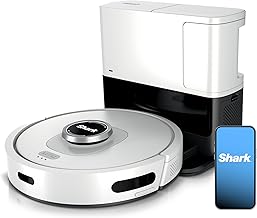
Shark AI Ultra AV2511AE: Best Self-Emptying Robot Vacuum for Pet Homes
Matrix Clean Navigation | Home mapping | 60-day self-empty base | Voice control
The Shark AI Ultra posts an EVS of 7.83 with a perfect 10/10 value score offset by a lower reliability sub-score of 6.49, driven by its 82-review sample — the smallest in this group. At $279.99, it offers the only branded self-emptying base with a 60-day capacity specifically marketed for pet homes, plus Matrix Clean Navigation for systematic coverage. The sparse review count is the primary drag on its score rather than any quality deficiency.

DREAME L50 Ultra: Best Premium Robot Vacuum for Large Homes
19,500Pa suction | Auto-empty & mop self-cleaning | HyperStream detangling duo brush
The DREAME L50 Ultra lands at EVS 7.50 — not because of performance shortcomings, but because its $799.99 price delivers the lowest value sub-score in the group at 6/10. Its reliability (8.69) and rating (8.4) scores are both strong, backed by 370 reviews at 4.2 stars. The 19,500Pa suction, detangling duo brush, and fully automated dock make it technically impressive, but the data shows you can get 83% of its EVS performance from the top-ranked L40 at $320 less.
Buying Guide
Our Scoring Methodology
Choosing the right robot vacuum and mop combo depends on your floor types, home size, budget, and how much manual maintenance you are willing to tolerate. This guide breaks down the key data points that matter most.
- 01. Self-Emptying Dock vs. Manual Emptying: Robot vacuums with self-emptying docks (like the DREAME L40, Shark AI Ultra, and DREAME L50) deposit debris into a sealed base that holds 30 to 60 days of dust and dirt. This eliminates daily bin emptying but adds cost and requires floor space for the dock. Budget models like the ROPVACNIC and eufy require manual emptying after each run, which takes seconds but becomes a daily chore.
- 02. Suction Power (Pa Rating): Suction power is measured in Pascals (Pa). In this group, suction ranges from 5,200Pa (ROPVACNIC) to 25,000Pa (DREAME L40). For hard floors, 2,000-5,000Pa is generally sufficient. For carpets, especially medium to high pile, look for 8,000Pa or higher. The DREAME models both exceed 19,000Pa, making them the strongest choices for mixed flooring with heavy carpet use.
- 03. Mop Functionality: Not all robot vacuums in this category include mopping. The DREAME L40, ROPVACNIC, and DREAME L50 offer combined vacuum-and-mop capability, while the eufy 11S MAX and Shark AI Ultra are vacuum-only. If you have hard floors that need wet cleaning, prioritize a combo unit. Check whether the mop pad is self-cleaning (DREAME models) or requires hand washing.
- 04. Review Volume and Reliability: Our EVS reliability score is heavily influenced by review volume. The DREAME L40 leads with 901 reviews, giving strong statistical confidence. The Shark AI Ultra has only 82 reviews, which — regardless of the product's quality — means less proven long-term reliability data. As a rule of thumb, products with 200+ reviews carry more reliable satisfaction signals than those with fewer than 100.
- 05. Price-to-Performance Ratio: The EVS value score normalizes features against price. The ROPVACNIC at $89.98 and the eufy at $149.99 both score 10/10 on value because they deliver core robot vacuum functions at budget pricing. The DREAME L50 at $799.99 scores 6/10 on value — not because it is a bad product, but because the marginal feature gains over the $479.99 DREAME L40 do not justify the $320 premium for most buyers.
Frequently Asked Questions
What is the EVS score and how is it calculated?
EVS stands for Evidence Value Score. It combines three sub-scores: value (price relative to features), reliability (review volume and consistency), and rating (aggregated star ratings with confidence adjustments). Each sub-score ranges from 0 to 10, and the composite EVS is a weighted average. A product with 900+ reviews and a strong price-to-feature ratio will typically score above 9.0.
Which robot vacuum and mop combo is best for pet owners?
The Shark AI Ultra AV2511AE is specifically marketed for pet homes with its 60-day self-empty base and hair-resistant design. However, the DREAME L40 Ultra Gen 2 (EVS 9.23) offers stronger 25,000Pa suction and a self-cleaning mop, which handles pet hair on both hard floors and carpets more thoroughly. For pet owners on a budget, the ROPVACNIC at $89.98 includes a mop and obstacle avoidance that performs well around pet bowls and toys.
Is a robot vacuum with 25,000Pa suction noticeably better than one with 5,200Pa?
Yes, but the difference depends on your flooring. On hard floors, the gap is minimal — even 5,200Pa picks up dust, crumbs, and hair effectively. On medium to high-pile carpets, 25,000Pa (DREAME L40) pulls embedded dirt and pet hair that lower-suction units leave behind. Our data shows the DREAME L40's 901-review base consistently rates carpet performance higher than budget models.
Are self-emptying docks worth the extra cost?
Based on our analysis, self-emptying docks add $130 to $320 to the price but eliminate the most tedious part of robot vacuum ownership. The DREAME L40 at $479.99 includes a self-emptying and self-cleaning dock with an EVS of 9.23, while the non-dock eufy 11S MAX at $149.99 scores 8.42. The dock premium is justified if you run daily cleaning cycles or have pets that generate constant debris.
Why does the DREAME L50 Ultra rank lower than the cheaper DREAME L40?
The DREAME L50 Ultra (EVS 7.50) actually has slightly better navigation and detangling features than the L40, but its $799.99 price drops its value sub-score to 6/10 compared to the L40's 10/10. The L40 also delivers higher suction (25,000Pa vs 19,500Pa) at $320 less. The EVS system rewards the L40 for offering more core performance per dollar, which is why it ranks first despite the L50's premium positioning.